Repair Or Sell?
My Car Is Not Worth Repairing — Can I Sell It for Cash in Sydney?
Yes, depending on the vehicle’s condition, age, make, model, parts value, scrap value and registration status, a car that isn’t worth repairing may still have resale, parts, wrecking or scrap value. There’s no fixed figure for every vehicle, but a car that’s uneconomical to fix is rarely worth nothing.
A mechanic’s quote that costs more than the car is worth is a familiar problem for a lot of Sydney vehicle owners. Maybe it’s a failed transmission, an engine that’s finally given out, accident damage that’s not worth claiming on, or simply a car that’s old enough that every repair feels like throwing money at a losing battle. In situations like these, spending more on repairs often doesn’t make financial sense, even if the car still runs.
Selling the vehicle instead of repairing it is a reasonable alternative in many of these cases. Whether a car ends up sold for parts, scrapped for metal, or resold to someone who can use it, it typically still holds some value, and Broken Car Collections works through vehicles across Sydney in exactly this position every week.
How Do You Know When a Car Is Not Worth Repairing?
Repair Cost vs. Vehicle Value
The decision usually comes down to a financial comparison rather than a purely mechanical one: what will the repair cost, versus what is the car actually worth once it’s fixed? If a $3,000 repair bill is being weighed against a car worth $2,500 on the used market, the maths rarely favours repairing it.
Common signs a vehicle may not be worth repairing include:
- Major engine failure, particularly where a replacement or rebuild is required
- Transmission failure, which is often one of the more expensive repairs on any vehicle
- Severe accident damage, especially where structural components are affected
- Rust or structural corrosion that goes beyond surface-level panel work
- Repeated mechanical failures that suggest deeper, ongoing issues
- Expensive electrical faults, which can be time-consuming and costly to diagnose
- Vehicle age combined with high kilometres, reducing the return on any repair spend
- Registration or roadworthiness issues that would require significant work to resolve
- An insurance write-off assessment, where the insurer has determined repair costs exceed the vehicle’s value
This article provides general guidance rather than mechanical or legal advice. If you’re unsure whether a repair is worthwhile, an independent mechanic’s assessment is the most reliable way to get a clear answer for your specific vehicle.
Can You Sell a Car That Is Not Worth Repairing for Cash in Sydney?
Yes, in most cases the vehicle still has some form of value
A car doesn’t need to be roadworthy or economical to repair to be worth selling. Value can come from several different places, often in combination:
Whole-Vehicle Resale
Some vehicles are still sellable as-is to a buyer who can repair or use them.
Used Parts
Engines, panels, electronics and other components can hold value even when the car doesn’t run.
Salvage Value
Accident-damaged vehicles are often assessed for what can be recovered rather than written off entirely.
Scrap Metal
The vehicle’s weight in recyclable metal contributes to its value, particularly for end-of-life cars.
Recyclable Components
Batteries, catalytic converters, wheels and other materials can be processed appropriately.
Combined Value
Most quotes reflect a mix of these factors rather than just one.
What’s actually offered depends on the make and model, year, condition, whether it runs, accident damage, demand for parts, how complete the vehicle is, its location, registration status, and current salvage or recycling values. There’s no fixed price that applies across every vehicle, which is why a proper assessment matters more than a generic estimate.
What Types of Cars Can Still Have Value?
Most vehicles in poor condition still fit somewhere on the spectrum
Broken Cars
Mechanical faults that make daily use impractical.
Non-Running Cars
Vehicles that won’t start or can’t be safely driven.
Accident-Damaged Vehicles
Cars affected by a collision, including repairable write-offs.
Old Cars
Vehicles that have simply reached the end of their practical life.
Unwanted Cars
Cars that are no longer needed, regardless of mechanical condition.
Scrap Cars
Vehicles suited to dismantling and metal recycling.
Engine/Transmission Problems
Major driveline faults that make repair uneconomical.
Failed Inspection
Vehicles that didn’t pass a roadworthy or pink slip inspection.
Unregistered Vehicles
Cars without current NSW registration.
Flood-damaged vehicles can also carry value in some circumstances, though the appropriate handling depends on the extent of the damage. If your situation is unusual, it’s worth describing it directly rather than assuming it rules the vehicle out.
Should I Repair My Car or Sell It?
There’s no single right answer for every vehicle
| Option | Potential Advantage | Possible Disadvantage |
|---|---|---|
| Repair the car | You keep a vehicle you’re familiar with | Repairs may cost more than the car is worth |
| Sell privately | Potentially reach retail buyers for a higher price | Takes more time, photos, ads and inspections |
| Trade-in | Convenient if you’re buying another car | Trade-in offers are often lower than other routes |
| Sell to a wrecker | Suitable for damaged or broken vehicles | Offer reflects parts and salvage value, not retail price |
| Scrap / recycle | A practical option for end-of-life vehicles | Value is largely based on scrap and material recovery |
The right choice depends on your specific repair estimate, how much the car is worth in its current condition, how reliable and safe it’s likely to be afterward, and what you’d otherwise spend on a replacement. If you’re weighing this decision more broadly, our guide on what to do with a car that’s not worth repairing in Inner West Sydney covers the same trade-offs in more detail.
Can I Sell a Car That Does Not Run?
Yes, a non-running vehicle can still be sold
A car that won’t start doesn’t need to be fixed before it’s sold. Non-running vehicles are regularly assessed for parts, salvage value and scrap metal, all of which don’t depend on the engine turning over. What matters more is describing the fault accurately, a seized engine, a blown head gasket, a dead electrical system and a simple flat battery all lead to different assessments, so accuracy helps avoid a mismatched offer later.
Can I Sell an Unregistered Car in Sydney?
Generally yes, with a few practical considerations
An unregistered vehicle can generally still be sold, but a few things are worth checking before you do: your ownership documentation, whether number plates need to be surrendered or transferred, and what NSW requires for transferring or disposing of a vehicle that isn’t currently registered. Safe removal and transport also need to be arranged, since an unregistered car typically can’t be legally driven on public roads.
Requirements can change and vary by circumstance, so for anything specific to your situation, it’s worth checking current information directly through Service NSW rather than relying on general guidance like this.
What Information Do I Need to Sell My Broken Car?
A quick checklist before you contact a buyer
- Make and model
- Year
- Vehicle condition — general state, cosmetic and mechanical
- Registration status — currently registered or not
- Kilometres
- Location — for collection planning
- Damage details — including any accident history
- Whether it starts or runs
- Major mechanical problems — engine, transmission, electrical
- Vehicle identification or documentation where applicable
- Photos, if requested
How Does Cash for Cars Work in Sydney?
A straightforward six-step process
What Happens to a Broken Car After It Is Sold?
Assessment, dismantling, recovery and recycling
Once a vehicle is collected, it typically moves through an assessment, then dismantling where appropriate, with reusable parts recovered and recyclable materials directed toward appropriate recycling streams. Not every vehicle follows an identical path, a car with strong resale potential may simply be sold on, while one that’s end-of-life is more likely to be broken down for parts and scrap. Usable components, panels, engines, electronics, can be given a second life in someone else’s repair, while metals and other recoverable materials are processed responsibly rather than left as landfill.
Is Selling My Broken Car Better Than Paying for Repairs?
A decision framework rather than a single answer
Rather than a blanket recommendation, it helps to weigh a few specific questions against each other:
- What does the repair estimate actually total, including parts and labour?
- What is the car realistically worth right now, in its current condition?
- Are further repairs likely in the near future, on top of this one?
- Is the vehicle reliable and safe to keep driving day to day?
- Is registration current, or would that add further cost and hassle?
- What has the maintenance history looked like over the past year or two?
- What would a replacement vehicle cost, and does that change the calculation?
If the answers point toward ongoing cost and uncertainty, selling is often the more practical route. If the repair is a one-off and the car has years of reliable use left in it, fixing it may still make sense. It genuinely depends on the vehicle in front of you.
How Much Could I Get for a Car That Is Not Worth Repairing?
There is no fixed cash value for every broken or scrap car
It’s tempting to want a ballpark figure upfront, but an honest answer depends on too many variables to generalise responsibly: make and model, year, condition, parts demand, scrap value, how complete the vehicle is, damage, location, running condition, and current market conditions for both used parts and scrap metal all play a role. Two seemingly similar cars can be worth quite different amounts once these factors are weighed individually.
The most reliable way to find out what your specific vehicle might be worth is to request an assessment rather than relying on a general estimate that wasn’t built around your car.
Cash for Cars vs. Car Wreckers vs. Scrap Car Removal
Overlapping categories with slightly different focuses
Cash for Cars
Focuses on purchasing a vehicle for its overall resale, salvage, parts or recycling value, whatever combination applies.
Car Wreckers
Vehicles may be dismantled, with usable components recovered and made available through the used-parts market.
Scrap Car Removal
Generally focused on unwanted or end-of-life vehicles and the materials that can be recycled from them.
In practice, these categories overlap significantly depending on the vehicle and the buyer’s own process. A single business, including Broken Car Collections, may function as all three depending on what a particular car needs.
Why Choose Broken Car Collections?
Practical, Sydney-based vehicle removal
Sydney-Area Coverage
We handle broken, damaged and unwanted vehicle collection across Sydney.
Damaged Vehicle Removal
Accident-affected and non-running cars are assessed rather than turned away.
Scrap Car Removal
End-of-life vehicles are collected and processed appropriately.
Car Wrecking & Recycling
Where a vehicle isn’t suited to resale, we work through dismantling and recycling instead.
Straightforward Enquiries
A call or WhatsApp message with your vehicle’s details gets the process started.
Vehicle-Specific Assessments
We look at your car’s actual condition rather than applying a blanket figure.
Local Sydney Relevance
Where this situation comes up across Sydney
This is a scenario we see regularly across different parts of Sydney, not just in one pocket of the city. In St Marys, where we’ve written specifically about selling a broken car, driveway space is often at a premium, which makes an unused vehicle a genuine inconvenience rather than just a cosmetic issue. The same applies across North St Marys, Willmot, Blackett, Ropes Crossing, Colyton, Oxley Park, Werrington, Whalan, Dharruk and Tregear.
Closer to the city, we’ve also covered how this looks specifically for disposing of an unwanted or broken car in Inner West Sydney, where parking restrictions and limited storage tend to be the bigger factor. Wherever you’re located across Sydney, the underlying decision, repair versus sell, tends to come down to the same handful of questions.
A Look At Our Yard
Real vehicles, real collections, not stock photography
A fuller set of photos from our own yard and car carriers, covering everything from fleet collection runs through to individual vehicles at different stages of assessment and dismantling.

Part of the Broken Car Collections crew who assess, collect and process vehicles across Sydney.

A stripped vehicle shell being moved by forklift after usable parts have been recovered.

A full carrier load, four vehicles collected in a single run around Sydney.

A four-car load including a wagon, a red sedan, an accident-damaged sedan and an SUV, back at base ahead of sorting.

Another full carrier, mixing smaller hatchbacks with an SUV and a sedan collected in the one run.

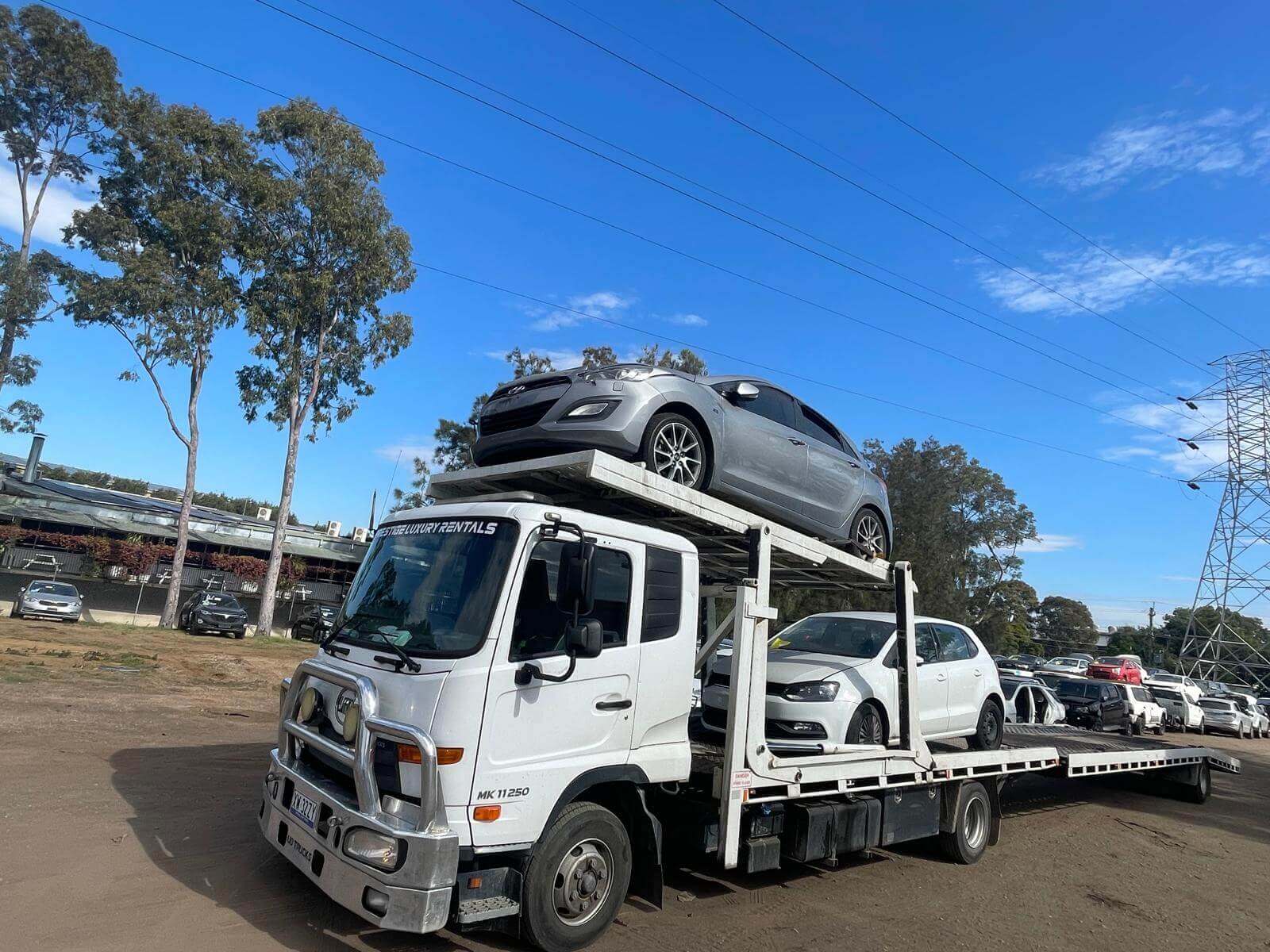
One of our two-tier carriers loaded and heading out after collecting vehicles from local sellers.
The same mixed load from a different angle and light, positioned in the yard ahead of unloading.

A hatchback already through initial dismantling, reusable parts pulled before the shell is recycled.

An SUV with serious front-end damage, assessed for salvageable parts rather than treated as a total loss.

A Civic sedan with rear-end collision damage, wrapped to protect the boot and tail-light assembly ahead of parts recovery.

A Tucson with heavy front-end impact damage, tagged as a freshly logged insurance write-off awaiting assessment.

A dual-cab ute with bumper, headlight and bonnet damage, one of several light commercial vehicles we regularly take in.

A recent arrival with a smashed windscreen and damaged interior, assessed for salvageable components.

A BMW X5 marked “Half-Cut,” meaning the front section has been separated for parts recovery.
Frequently Asked Questions
Common questions about selling a car that’s not worth repairing
Can I sell a car that is not worth repairing?
Yes. Even when repairs aren’t financially worthwhile, a vehicle can still have resale, parts, salvage or scrap value depending on its make, model, condition and completeness.
Is a broken car still worth money?
Often, yes. A broken car can hold value through reusable components, scrap metal weight, or resale to someone able to repair it, even if it’s not worth fixing for the current owner.
Can I sell a car that does not run?
Yes. Non-running vehicles are regularly bought for parts, salvage or scrap value. Describe the fault accurately when requesting an offer, as it affects the assessment.
Can I sell an unregistered car in Sydney?
Generally, unregistered vehicles can still be sold, but ownership documentation and registration status should be checked. For current NSW requirements, refer to Service NSW.
How do I sell a damaged car for cash?
Contact a buyer with the vehicle’s make, model, year, condition and damage details, then compare the offer against repair costs and other selling options before deciding.
Should I repair my car or sell it?
It depends on the repair estimate, the car’s current value, its reliability and safety, and what a replacement would cost. There’s no single right answer for every vehicle.
How is a broken car valued?
Valuation typically considers make, model, year, condition, completeness, parts demand, scrap value and running status, rather than a fixed price list.
Can car wreckers buy cars with major mechanical problems?
Yes. Engine or transmission failure doesn’t rule a vehicle out, wreckers assess it for salvageable parts and scrap value instead.
What happens to my car after it is collected?
Depending on condition, a vehicle may be resold, dismantled for reusable parts, or directed toward scrap metal recycling. Not every vehicle follows the same path.
How can I arrange broken car removal in Sydney?
Contact Broken Car Collections with your vehicle’s details, and if you proceed with an offer, collection can be arranged at a time that suits you.